
The Municipality of Kincardine's Smart Beach program is piloting a new dynamic warning system this summer.
Council approved a Memorandum of Understanding with SwimSmart Technology and the University of Waterloo to integrate the forecasting model developed in previous years into a new real-time warning system.
Kincardine has been gathering beach data since 2022. The Smart Beach program was originally funded by the Municipal Innovation Council, which folded last year.
Jacob Soter, Managing Director of SwimSmart, said the system will look at wave height, wind speeds, and current strength to determine what the warning level will be.
"One of the biggest contributors to drownings in the Great Lakes is primarily wave-driven, so by forecasting the winds we can predict the waves, and by predicting the waves, we have a pretty good idea of hazardous conditions," he told council. "The goal is not to necessarily indicate to any particular swimmer whether conditions are hazardous, it's more to provide what we call happy sea or angry sea."
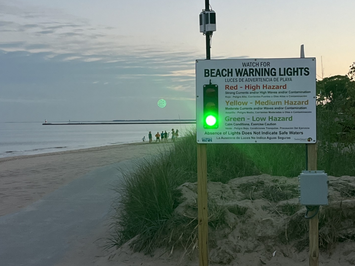
Council also approved an additional $20,500 in spending for a new solar powered flashboard that will display green, yellow, or red risk warnings to beachgoers in real time.
Soter said while SwimSmart has these boards in the United States, this would be new technology for Canada.
"The thing that's different compared to other municipalities we've worked with, for a lot of our other impelmentations, it directly uses the (national) weather service feed," he said. "That is not the case with this, we're working with a Canadian university to develop this model. Canada does not have a nearshore wave model like the US does... this would be the first of its kind in Canada as far as I've seen."
Soter said there's also safety mechanisms in place to turn the light off if the system is not responding.
The MOU is only for this summer, but the Municipality could continue the program beyond that for a small annual fee.
Soter said this trial is not only about honing the model, but learning how people react to the warning system.
"Part of the research that Waterloo is doing is not just the model but the social science behind it," he said. "That's the most unique aspect of this project, we're really going to get good definition on how people percieve and change their behaviour, how people are affected with signage and things like that."
The system is set to be operational on May 1 and run until September 30.