

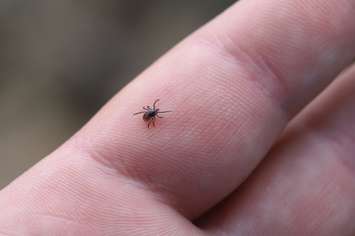
Wellington Dufferin Guelph Public Health (WDGPH) is warning residents that a substantial increase in the risk of exposure to ticks carrying Lyme disease requires increased vigilance.
Health officials revealed that the number of tick reports in the region has skyrocketed, and residents should take additional precautions.
"We've conducted surveillance over the last few years, and what we've seen is a significant, I would say, increase in tick populations," said Phil Wong, Director of Operations for Health Protection at WDG Public Health. "Particularly the black-legged tick, that spreads Lyme disease, has appeared in parts of our communities that we've never seen it in before."
In 2024, Wong shared that active surveillance included 200 people who submitted photos of ticks, and he expects the number for 2025 to be even higher. Many of the ticks were engorged after being attached to their host.
"We've seen just an explosion of black-legged ticks," he added. "So in 2024, there were 134 Blacklegged ticks submitted. In 2023, it was about 73. So almost double."
In 2024, there were 28 human cases of Lyme disease in residents of the Wellington, Dufferin, and Guelph area. However, not all victims were exposed in the region.
WDGPH has released updated guidance to combat a growing tick population that is proving to be more resilient and widespread than in years past. While many people associate tick risks with the height of summer and deep, wooded forests, experts say that perspective is outdated.
"People are often most vigilant about ticks around long grass and during summer, but that is no longer the full picture," Wong continued. "As ticks become more prevalent in the community, we want residents to rethink tick risks and make sure they take the proper precautions."
One of the most significant shifts in the new guidance is the move toward year-round vigilance. The Health Unit says black-legged ticks, the primary carriers of Lyme disease, do not strictly follow a seasonal calendar. Instead, they remain active whenever temperatures climb above zero degrees Celsius. This means a mild winter afternoon or a brisk early spring morning can carry just as much risk as a humid July day.
Public Health is now recommending full-body tick checks for adults, children, and pets following any outdoor activity, regardless of the date on the calendar.
"We have so many beautiful trails, parks and outdoor areas within our region. Continue to go out and camp and hike and bike," Wong declared. "The one thing that folks should be looking into, though, is doing a tick check. So when you get home, just check the body. Make sure you have no hitchhikers, as in ticks, and check your pets, too."
In response to the increasing numbers, WDG Public Health has streamlined how residents can identify the ticks they find. The health unit has moved away from traditional lab testing of physical samples, opting instead for a modern, digital approach. Community members are encouraged to use a new online photo submission tool.
"It's not meant for diagnosis, the service, but when you do submit your tick, we ask you a couple of questions, right? We want to know where you were potentially exposed," Wong shared. "What were you doing? Perhaps, what community you're in and that really helps us drive where we can do additional initiatives."
By visiting the health unit's website and uploading a clear image of a tick, residents can receive timely identification and professional guidance on potential health risks.
To stay protected, officials suggest wearing light-colored clothing to make ticks easier to spot, using repellent containing DEET or icaridin, and keeping lawns mowed short.
For more information on how to perform a proper tick check or to submit a photo for identification, residents can visit wdgpublichealth.ca/ticks.