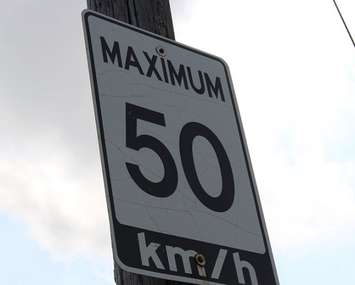
West Grey council has approved a new Speed Limit Evaluation Policy to establish a consistent, evidence-based process for reviewing posted speed limit change requests on municipal roads.
Director of Public Works and Engineering Jeff Fried explained that the policy aims to make traffic management decisions across the municipality more transparent, predictable, and fair.
"One of the key elements of this process is to have the documentation and the consistency for whoever is sitting in this seat," he added. "It provides consistent documentation and response to our traffic speed concerns going forward."
During discussions, Councillor Geoffrey Shea said he liked the framework.
"I'm very supportive of the initiative that's being presented here," he noted. "Making our traffic management, speed reduction, or speed management processes more transparent and more accessible."
Under the newly adopted policy, speed limit decisions will rely on technical evaluations and complete roadway context rather than operating speed alone.
Staff will assess data such as vehicle volumes and the 85th percentile speed, which is the rate at or below which 85 per cent of traffic travels under free-flow conditions, alongside physical conditions like road geometry, lane widths, stopping sight distances, and clear-zone hazards.
The framework also places specific emphasis on surrounding land use, giving extra weight to safety concerns near schools, parks, trails, community facilities, and residential settlement areas, as well as considering five-year collision histories where data is available.
The evaluation process runs through a structured two-stage review model. Requests initiated by members of the public, council, or municipal staff will first undergo an initial screening to confirm municipal jurisdiction, verify road classifications, and check whether physical conditions or traffic patterns have changed since any previous reviews. If a location passes screening, staff will move forward with a technical evaluation to gather representative traffic data and conduct detailed engineering assessments. Requests involving county roads or provincial highways fall outside municipal jurisdiction and will be directed to the appropriate governing road authorities.
The policy clarifies that lowered speed limits will not be used as a stand-alone fix for localized physical or geometric issues. Where physical road features or sight lines pose a hazard, staff will first evaluate targeted engineering fixes, warning signs, advisory markers, or traffic calming tools before recommending a lower regulatory speed limit.
Any regulatory changes recommended by engineering staff will continue to require formal approval from Council and the enactment of a municipal by-law under Ontario's Highway Traffic Act before new signs are installed and enforced. Staff will re-evaluate the policy framework at least once every four years to stay aligned with evolving provincial standards and local operational needs.